Aviation & Airport Jobs in Cyprus: What's Available at Larnaca and Paphos Airports
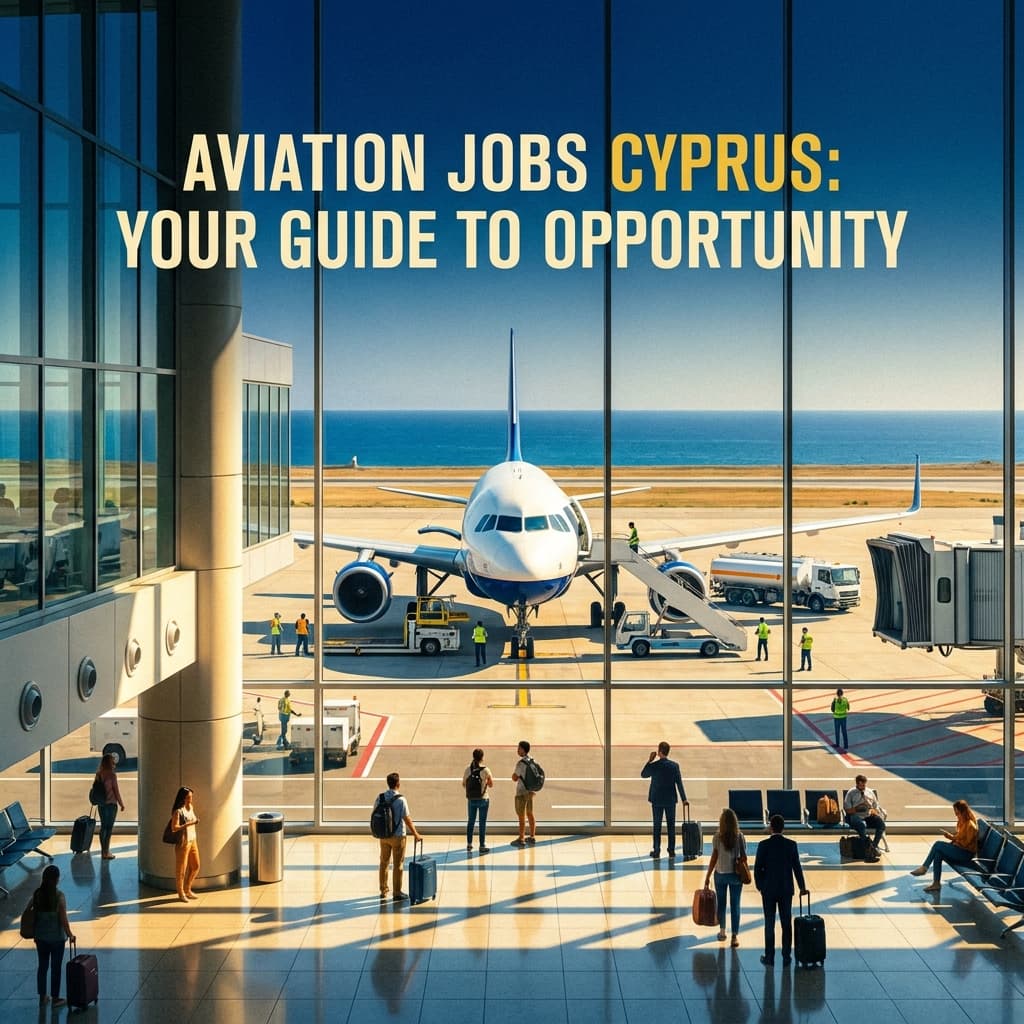
Cyprus Aviation: Bigger Than It Looks
Cyprus operates two international airports — Larnaca International Airport (LCA) and Paphos International Airport (PFO) — both managed by Hermes Airports under a long-term concession agreement. Together, they handle over ten million passengers per year, making aviation one of the most economically significant sectors on the island. For an island of Cyprus's size, this volume is remarkable, and it creates a sustained demand for airport and aviation professionals across the full spectrum of disciplines: ground operations, security, technical engineering, air traffic control, management, retail, and food and beverage.
Despite its size, the Cyprus aviation employment market is often overlooked by job seekers who associate major aviation careers only with hub airports like Heathrow or Frankfurt. In reality, Larnaca and Paphos offer a full range of aviation roles in a concentrated, approachable environment — and for someone at the beginning of an aviation career, getting an airport ID and building experience in Cyprus can be an excellent launchpad.
The Structure of Cyprus Airport Employment
Understanding who actually employs people at an airport is essential. Jobs at Larnaca and Paphos are spread across multiple employers — not just Hermes Airports itself:
Hermes Airports — the airport operator; employs management, operations, commercial, IT, finance, and HR staff directly
Ground handling companies — provide ramp services, passenger services, cargo handling, and aircraft cleaning on behalf of airlines; the largest employment category at most airports
Airlines — Cyprus Airways and foreign carriers operating in Cyprus employ cabin crew, check-in agents, and base staff; some roles are locally based, others are recruited from airline headquarters abroad
Air Traffic Control (DCAC) — the Department of Civil Aviation manages Cypriot airspace; employs ATCOs, flight information officers, and technical staff
Airport Security — government-contracted security companies provide passenger and baggage screening and access control
Retail and F&B concessions — duty-free operators (Hellenic Duty Free Shops), restaurants, cafés, and lounges employ significant numbers, particularly at Larnaca which has a large international transfer passenger base
Maintenance, repair, and overhaul (MRO) — aircraft maintenance organisations licensed by the Cyprus Department of Civil Aviation perform line maintenance at both airports
Freight and cargo operators — both airports handle air cargo, employing logistics coordinators, cargo agents, and customs specialists
Ground Operations Roles
Ground handling is the single largest employment category at Cyprus airports and the most accessible entry point for people without prior aviation experience. Ground handlers manage everything that happens to an aircraft and its passengers between landing and takeoff.
Ramp Agent
Ramp agents perform the physical work of aircraft turnaround — loading and unloading baggage and cargo, operating ground support equipment (belt loaders, tugs, pushback tractors), marshalling aircraft, connecting ground power, and managing waste removal. No formal aviation qualification is required — full training and equipment licensing is provided by the employer.
Requirements: Physical fitness, valid driving licence, clean background check, willingness to work shifts (including nights and weekends)
Salary: €1,350 – €1,800/month; typically rises with shift differentials
Progression: Lead Ramp Agent → Ramp Supervisor → Ground Operations Manager
Passenger Service Agent
Passenger Service Agents (PSAs) are the public face of ground handling — they work check-in desks, boarding gates, arrival halls, and customer service points. Strong communication skills and the ability to handle stressed passengers professionally are as important as technical knowledge.
Requirements: Good English (minimum B2), additional languages highly valued (Russian, German, French are useful given Cyprus's passenger mix); customer service background; ability to work rotating shifts
Salary: €1,400 – €2,000/month, depending on language skills and seniority
Progression: Senior PSA → Duty Manager → Station Manager
Load Controller (Loadmaster)
Load controllers calculate aircraft weight and balance — a safety-critical function that determines how passengers, baggage, and cargo are distributed across each aircraft. They communicate load plans to pilots and are responsible for ensuring every departure meets safety parameters.
Requirements: Completion of a recognised load control training programme (IATA load control course or equivalent); mathematical aptitude; high attention to detail
Salary: €2,000 – €3,200/month
Aircraft Cleaning / Cabin Services
Aircraft cleaning crews turn around aircraft interiors between flights — restocking galleys, cleaning cabins, and preparing the aircraft for the next departure. This is the easiest point of entry into airport employment.
Requirements: No formal qualifications; full training provided; willingness to work to tight turnaround schedules
Salary: €1,200 – €1,500/month
Security Roles
Airport Security Officer
Security officers operate passenger screening checkpoints, baggage X-ray machines, and access control points. The role carries significant regulatory responsibility — airport security in Cyprus operates under EU Aviation Security (AVSEC) regulations, and all security staff must hold current certification.
Requirements: AVSEC basic training certificate (provided as part of induction by the employer); clean criminal background check (this is thorough and mandatory); physical fitness; ability to make fast decisions in high-pressure situations
Salary: €1,500 – €2,200/month; typically includes shift allowances
Progression: Supervisor → Security Manager → Head of Security
Technical and Engineering Roles
Aircraft Maintenance Engineer (AME)
AMEs perform scheduled and unscheduled maintenance on aircraft and are legally authorised to certify aircraft as airworthy for the next flight. This is a highly regulated, highly paid, and highly skilled profession.
Requirements: EASA Part-66 Aircraft Maintenance Licence (Category A, B1, or B2 depending on specialisation); type ratings for specific aircraft types; significant practical maintenance experience
Salary: €40,000 – €80,000/year depending on licence category and type ratings held
Demand: Chronic shortage of qualified AMEs across Europe; Cyprus-based MROs compete for licensed engineers
Avionics Technician
Avionics technicians specialise in the electronic systems of aircraft — navigation, communication, autopilot, and flight management systems. Typically requires a Part-66 B2 licence or equivalent avionics qualification.
Salary: €35,000 – €65,000/year
Airport Infrastructure and Facilities
Hermes Airports employs civil, mechanical, and electrical engineers for the ongoing maintenance and development of terminal buildings, runways, taxiways, and airport systems. These are typically permanent positions requiring relevant engineering degrees and experience.
Salary: €35,000 – €65,000/year depending on seniority
Air Traffic Control
Air Traffic Controller (ATCO)
ATCOs are among the highest-paid professionals in aviation and the broader Cyprus employment market. They manage the separation of aircraft in Cypriot airspace — one of the most demanding and safety-critical jobs in any sector. Becoming a fully licensed ATCO requires completing an approved training programme (3–4 years typically) and passing rigorous competency assessments.
Requirements: ATCO licence from an EASA-approved training provider; operational endorsements for the specific sectors (aerodrome, approach, area control); current medical certificate; high-level English; exceptional situational awareness and stress tolerance
Salary: €55,000 – €100,000+/year for experienced operational ATCOs
Flight Information Officer (FIO)
FIOs provide flight information and alerting services to pilots — a less demanding but related role to full ATC. Requires completion of a Flight Information Service (FIS) course.
Salary: €28,000 – €50,000/year
Airline and Cabin Crew Roles
Cabin Crew
Cyprus Airways and foreign carriers with Cyprus bases recruit cabin crew. Cabin crew are primarily responsible for passenger safety during flight, with in-flight service secondary. Most airlines conduct Cyprus-based recruitment rounds periodically.
Requirements: Minimum age 18; minimum height (typically 158–185 cm for reach requirements); fluent English plus ideally one additional language; valid swimming ability; customer service background; medical fitness certificate; full initial training provided by the airline
Salary: Typically €1,400 – €2,500/month base, plus significant flying hour supplements depending on routes
Commercial Pilot (CPL/ATPL)
The most qualification-intensive role in aviation. A commercial pilot must hold a current EASA CPL or ATPL, a type rating for the relevant aircraft, and a current Class 1 medical certificate. Entry-level first officers at regional airlines in Cyprus earn €45,000–€70,000/year; senior captains on wide-body aircraft earn €100,000–€200,000+/year.
Retail, F&B, and Commercial Concessions
Both airports host significant commercial operations. Hellenic Duty Free Shops operates duty-free retail across multiple outlets at Larnaca. Restaurant, café, and lounge operators employ servers, baristas, kitchen staff, and managers. These roles follow retail and hospitality employment norms in terms of pay and requirements — English is essential; shift flexibility is expected; customer service experience is valued.
Seasonal vs. Permanent Employment in Cyprus Aviation
Cyprus aviation is deeply seasonal. The summer schedule (broadly April through October) sees passenger numbers approximately three times higher than the winter trough. Ground handlers and retail/F&B operators recruit significantly for the summer season each year — typically advertising from February through April for May start dates. This seasonal cycle creates an important entry-level opportunity:
Seasonal contracts allow people without prior airport experience to enter, get their airport security ID (AVSEC badge), build their aviation CV, and demonstrate their suitability for a permanent role
Ground handlers regularly convert strong seasonal staff to permanent positions as turnover creates vacancies
The summer season is also when airlines increase frequency to Cyprus, creating temporary cabin crew and handling vacancies
How to Apply
Hermes Airports careers page (hermesairports.com) — for airport authority management, operations, IT, and commercial roles
Swissport Cyprus — ground handling roles at both airports; check Swissport's global careers portal filtering for Cyprus
Cyprus Airways — cabin crew and ground operations roles
DCAC (dcac.gov.cy) — ATC and civil aviation regulatory roles
This job portal — aviation and transport category updated as employers post vacancies
LinkedIn — effective for managerial, technical, and specialist aviation roles; less used for entry-level ground handling
Direct speculative applications — particularly for smaller MRO organisations and cargo operators who may not advertise widely
Universal Requirements Across Most Airport Roles
Clean criminal background check (thorough and non-negotiable for security ID)
Airport Airside Pass / AVSEC badge (issued after successful background check and induction training)
Good English language skills (B2 minimum across all customer-facing and technical roles)
Willingness to work rotating shifts, nights, weekends, and public holidays
Physical fitness for ramp, security, and technical roles
Valid driving licence (Category B minimum for most airside roles)
Final Thoughts
Cyprus's two international airports offer a genuine and often underestimated range of aviation employment opportunities. From the easiest entry-level ramp or cleaning role through to some of the highest-paid professional positions in any industry (AME, ATCO, senior pilot), the aviation ecosystem at Larnaca and Paphos covers the full professional spectrum. For those early in an aviation career, the seasonal entry route is a well-worn path to getting airside experience that opens doors to the broader industry — in Cyprus and beyond.
Frequently Asked Questions
Do I need to speak Greek to work at Cyprus airports?
No. English is the working language for virtually all operational, technical, and customer-facing roles. Most ground handling, security, and airline operations are conducted entirely in English. Greek is socially useful in Cyprus day-to-day life but is not a job requirement in most airport roles.
How long does the background check process take before I can start working?
The AVSEC background check process in Cyprus typically takes 2–6 weeks depending on the complexity of the check (number of countries you have lived in, name changes, etc.). You cannot work airside without a cleared background and valid airport pass. Factor this into your start-date expectations when applying.
Are there full-time year-round opportunities or mainly seasonal?
Both exist. Hermes Airports, ATC, MRO companies, and permanent airline base staff are year-round. Ground handling companies and retail/F&B concessions have a significant seasonal component but maintain permanent core staff throughout the year.
Looking for jobs in Cyprus?
Browse thousands of opportunities across all industries on Evresio.
Browse Jobs on EvresioRelated Articles

Education Jobs in Cyprus: Teaching Positions and Requirements
From public school teaching to international schools, university lecturing, and EFL instruction — here is a comprehensive guide to finding an education job in Cyprus, with requirements and salary expectations for every sector.

Shipping & Maritime Jobs in Cyprus: Roles, Pay, and How to Apply
Cyprus is one of the world's leading ship management centres. Discover the full range of roles in the maritime sector, what they pay at every level, and how to break into this specialised and well-compensated industry.

Women in the Cyprus Workforce: Progress, Gaps, and Opportunities
An honest look at where women stand in the Cyprus workforce — sector representation, the gender pay gap, legal protections, and practical strategies for career advancement.