How to Write a CV That Gets You Hired in Cyprus
Why Your CV Matters More Than You Think
In a market where a single job posting in Cyprus can attract 80–200 applications, your CV has one job: get you to the interview. Not to secure you the role. Not to tell your entire career story. Just to earn you a conversation.
Most CVs fail at this because they're written for the candidate, not the recruiter. They list everything the candidate has ever done in the order they did it, with no thought given to what a hiring manager is actually scanning for in 30 seconds.
This guide teaches you to write a CV that passes the 30-second scan, satisfies the detailed read, and ultimately gets the phone to ring. We've tailored it specifically to the Cyprus job market — because the conventions here differ from the UK, US, and much of Northern Europe in ways that genuinely matter.
Understanding What Cyprus Employers Actually Want
Before you write a single word, understand who is reading your CV and what they care about.
Cyprus hiring decisions are typically made by one of three people: an HR manager at a larger company, the business owner directly at an SME, or a recruiter at a staffing agency. Each reads slightly differently:
HR managers scan for keywords first (does this person have the right experience?), then evaluate presentation (is this professional?), then read for substance.
Business owners tend to read more holistically — they're assessing character and cultural fit alongside competence. They want to understand who you are, not just what you've done.
Recruiters move fastest and scan hardest — they're matching your profile to a specific brief and move on within 20 seconds if it's not a fit.
What all three share: they are busy, they have limited time per CV, and they will not "read between the lines" to give you credit for things you haven't clearly stated. Your CV needs to make the case for you — explicitly and efficiently.
The Cyprus-Specific Conventions You Need to Know
Several practices that are standard in Cyprus would be considered unusual or even inappropriate in the UK, US, or parts of Northern Europe. Get these right.
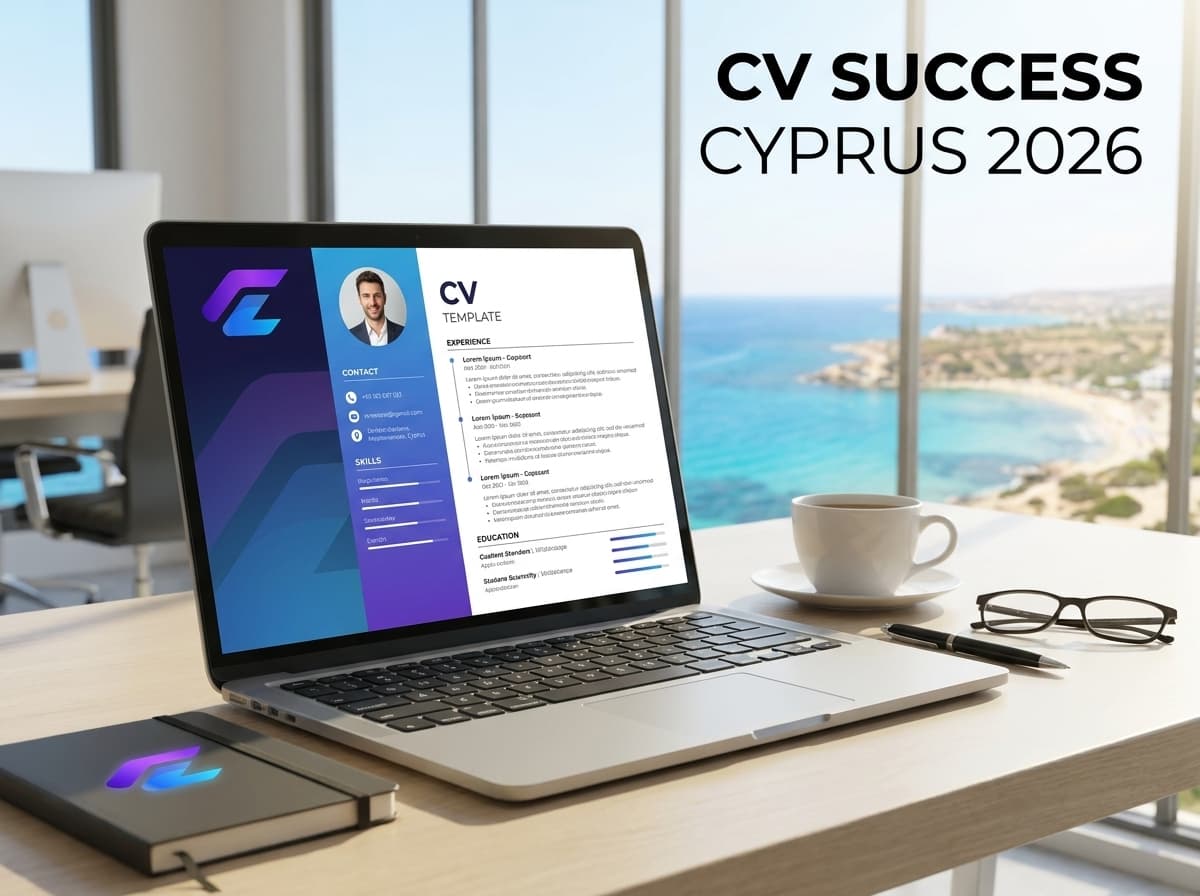
Include a Professional Photo
A professional headshot is expected on a Cyprus CV. This is standard practice across Southern and Eastern Europe and reflects a business culture where personal presentation and first impressions matter. Omitting a photo doesn't make your CV look more professional here — it tends to stand out as unusual.
Requirements for the photo: taken within the past 2 years, professional attire (not a holiday selfie), neutral or plain background, good lighting, direct but relaxed expression. Think passport photo quality, but warmer.
Include Your Languages
Cyprus is a multilingual business environment. English is required for almost every professional role in the private sector. Greek is expected for roles involving local clients, public sector work, or customer-facing positions. Additional languages — particularly Russian, Arabic, Hebrew, French, German, Spanish, or Chinese — can meaningfully differentiate your application in sectors like finance, real estate, and hospitality.
Be precise about your level. Use the Common European Framework of Reference (CEFR) scale: A1/A2 (basic), B1/B2 (intermediate), C1/C2 (advanced/native). "Conversational Greek" and "Fluent Greek" are not interchangeable — be accurate.
Personal Information Section
At the top of a Cyprus CV, include: full name, phone number, email address, current city (you don't need a full street address), LinkedIn profile URL if it's up to date, and optionally your nationality and work permit status if you're a non-EU national (this removes a common question from the recruiter's mind early).
Marital status and date of birth are no longer required on Cyprus CVs, though you may still see older-format templates that ask for them. You don't need to include these.
CV Structure: The Right Order
A well-structured Cyprus CV follows this order:
Personal details + photo
Professional summary (3–4 lines)
Work experience (reverse chronological)
Education
Skills
Languages
Certifications / Professional memberships (if relevant)
References are typically not included on the CV itself — "References available upon request" as a line at the bottom is sufficient and saves space.
The Professional Summary: Your Most Valuable Real Estate
The professional summary sits directly below your name and contact details — it's the first piece of content a recruiter reads, and it sets the frame for everything that follows. Get it wrong, and nothing else matters. Get it right, and you've already created a positive bias before they read a single bullet point.
A good professional summary is 3–4 sentences that answer three questions:
Who are you professionally (your title, years of experience, area of expertise)?
What's your most significant achievement or distinguishing quality?
What are you looking for next?
Weak example: "Hardworking and motivated professional with experience in finance looking for a new opportunity to grow my career in a dynamic company."
Strong example: "AML Compliance Officer with 6 years of experience in Cyprus's forex and CFD industry, specialising in KYC onboarding and transaction monitoring for high-risk jurisdictions. Reduced false-positive alert rates by 35% at my current firm through a process overhaul I designed and led. Seeking a senior compliance role with scope to build and manage a team."
The second version is specific, credible, achievement-led, and tells the reader exactly where you want to go. The first version could be anyone — which means it helps no one.
Writing Your Work Experience
This is the core of your CV and where most candidates both invest the most effort and make the most mistakes.
Use Reverse Chronological Order
Always list your most recent role first. Recruiters read top to bottom — your current or most recent position should be immediately visible, not buried after a long education section.
The Right Format for Each Role
For each position, include:
Job title (bold)
Company name | City | Dates (month/year to month/year, or "Present")
3–6 bullet points describing your responsibilities and achievements
The Achievements Rule: Numbers, Not Descriptions
The single most impactful change you can make to your CV is replacing responsibility descriptions with achievement statements. Responsibility descriptions tell the reader what your job was. Achievement statements tell them how well you did it — which is what they're actually trying to evaluate.
The formula is simple: Action verb + what you did + the result (with a number).
Instead of "Managed client accounts" → "Managed a portfolio of 45 corporate clients with combined AUM of €12M, achieving 94% annual retention"
Instead of "Responsible for social media" → "Grew company LinkedIn following from 800 to 4,200 in 12 months, generating 3× increase in inbound enquiries"
Instead of "Oversaw hotel front desk operations" → "Led a team of 8 front desk staff across a 220-room property, reducing guest check-in wait times from 8 minutes to under 3 minutes"
Not every bullet point will have a number — some responsibilities genuinely don't lend themselves to quantification. But aim for at least two thirds of your bullet points to include a specific result, percentage, volume, or timeframe.
Use Strong Action Verbs
Start every bullet point with a strong, specific verb. Avoid weak openers like "Responsible for," "Helped with," or "Involved in." Strong alternatives: Led, Developed, Implemented, Managed, Designed, Negotiated, Delivered, Reduced, Grew, Launched, Restructured, Streamlined, Trained, Secured.
Tailor for Each Application
This is non-negotiable and the step most candidates skip. Read the job description carefully. Identify the four or five most important requirements — usually found in the top half of the "Requirements" section. Ensure your CV addresses each one directly, either through your summary or your bullet points. If the JD mentions "experience with MT4/MT5 platforms" and you have it, it needs to be visible and explicit on your CV — not something the recruiter has to infer.
Tailoring doesn't mean rewriting your entire CV for every application. It means adjusting your summary and reviewing your top three bullet points for your most recent role to make sure they speak directly to what this specific employer is looking for.
Education Section
For candidates with 3+ years of experience, education appears below work experience. For recent graduates, it comes immediately after the summary.
Include: degree title, institution name, country, years attended, and grade if it's strong (First Class, 2:1, or equivalent). If your degree is from a non-English-speaking institution, include a brief note explaining the grading system if it's non-obvious to a Cypriot reader.
Professional qualifications — CFA, ACCA, CySEC licences, ACA, CISI, RICS — are extremely valuable in Cyprus and should be listed prominently, either in the education section or in a dedicated "Certifications and Qualifications" section near the top.
Skills Section
Keep it clean and relevant. Group skills logically:
Technical/software skills: specific platforms, tools, and systems (e.g., Bloomberg Terminal, Salesforce, SAP, MetaTrader, Adobe Suite)
Industry-specific skills: relevant to your sector
Soft skills: use these sparingly and only if you can back them up with evidence. "Strong communicator" without context is noise; "Presented quarterly performance reports to the board of directors" shows communication skills without claiming them.
Common CV Mistakes Cyprus Employers Notice
Having reviewed the hiring practices of companies across multiple sectors in Cyprus, these are the mistakes that consistently result in CVs being passed over:
Too long. Three pages or more, particularly for candidates with under 10 years' experience, signals an inability to prioritise. Two pages is the standard; one page is fine for junior candidates.
Unexplained gaps. A gap of more than three months without any explanation raises questions. You don't need to justify every break in detail, but a brief note ("Career break — personal development / relocation") removes the distraction.
Generic objective statements. "Looking for a challenging role in a dynamic company" tells the reader nothing. Replace with a specific professional summary.
Inconsistent dates. If your dates don't add up or there are overlaps that aren't explained (e.g., two full-time jobs simultaneously), recruiters will notice and wonder.
Spelling and grammar errors. In Cyprus's professional market, where English is used as the business language but is often not the first language, errors are noticed and taken seriously. Proofread carefully — ideally by someone whose first language is English.
Using a generic email address. A professional email address ([email protected]) signals basic professional awareness. Using an old address from university or a nickname looks careless.
Missing contact information. Surprisingly common. Ensure your phone number and email are clearly visible at the top.
An outdated or unprofessional LinkedIn profile. Many recruiters will check your LinkedIn within minutes of opening your CV. If your profile is incomplete, out of date, or says something different from your CV, it creates doubt.
Should You Include a Cover Letter?
In Cyprus, cover letters are not universally required but are always valued when done well. A well-written cover letter demonstrates genuine interest in the specific company and role — qualities that differentiate you from the pool of generic applicants.
A cover letter for a Cyprus employer should be no longer than half a page. It needs to answer three questions clearly: Why this company? Why this role? Why you? If you can answer those three questions with specifics rather than generalities, your cover letter will stand out.
If a job posting specifically requests a cover letter, not including one is an immediate disqualifier. If it's not requested, including a strong one is an advantage. If you don't have time to write a genuinely good one, don't write a generic one — a weak cover letter can actually create a negative impression.
Formatting and Presentation
Content is everything, but presentation matters too. A few non-negotiables:
Font: Calibri, Garamond, Georgia, or Arial. Size 10–11 for body text, 14–16 for your name. No Comic Sans. No cursive fonts.
Margins: 1.5–2cm on all sides. Cramming text to the edges looks desperate and is hard to read.
Format: Submit as a PDF unless specifically asked for Word. PDFs preserve your formatting across any device or operating system.
File name: FirstName_LastName_CV.pdf — not "My CV final v3 (1).pdf".
Colour: Minimal is fine. A subtle accent colour on section headings is acceptable. Multi-colour designs or heavy graphic elements are appropriate for creative roles only — for finance, legal, and corporate roles, clean and professional wins every time.
Using Evresio's CV Builder
If you're starting from scratch or want to make sure your CV follows the right format for the Cyprus market, Evresio's built-in CV builder gives you professionally designed templates that follow all the conventions in this guide. Choose from multiple formats, fill in your details, and download a polished PDF ready to send — no design skills required.
Final Checklist Before You Send
Before you hit send on any application, run through this list:
Professional photo included?
Contact details clearly visible (phone + email)?
LinkedIn URL included and profile up to date?
Professional summary specific to this application?
Work experience in reverse chronological order?
At least 60% of bullet points include a quantified achievement?
Languages listed with accurate CEFR levels?
No spelling or grammar errors (proofread at least twice)?
CV is maximum two pages?
Saved and sent as a PDF?
File named professionally?
Tailored summary and top bullet points to match this specific JD?
If you can tick all twelve boxes, your CV is in the top tier of what most hiring managers in Cyprus will see. That doesn't guarantee an interview — the role fit still has to be there — but it removes every avoidable reason for your application to be dismissed.
Browse current openings on Evresio and put your updated CV to work.
Looking for jobs in Cyprus?
Browse thousands of opportunities across all industries on Evresio.
Browse Jobs on Evresio