What Cyprus Employers Actually Look for in a CV in 2026
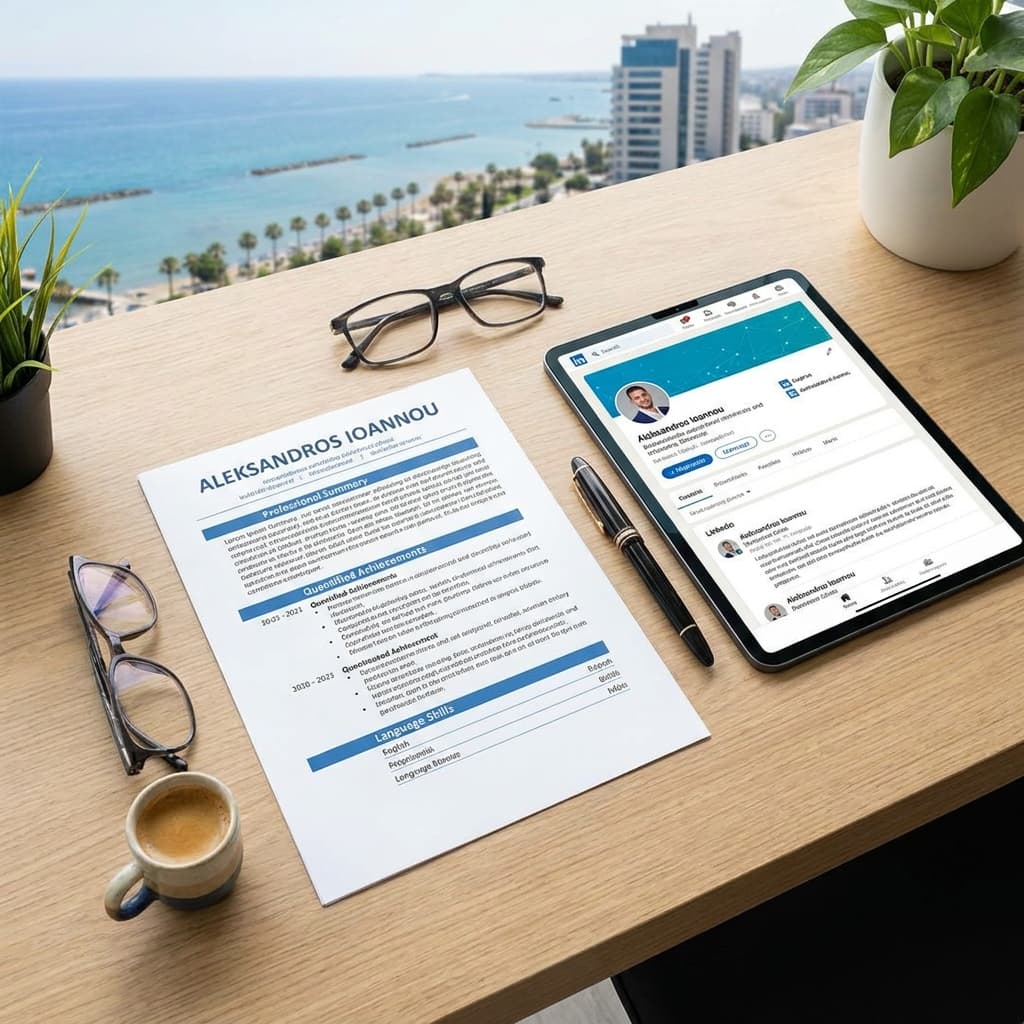
What Hiring Managers in Cyprus Actually Read First
Most candidates think the goal of a CV is to list everything they have done and let the hiring manager connect the dots. Most hiring managers in Cyprus spend less than 30 seconds on an initial CV review before deciding whether to read further. Those two facts together explain why so many well-qualified candidates fail to get interviews — not because they lack the experience, but because their CV does not communicate it in the way that actually gets read.
This guide is built from the patterns that appear consistently when Cyprus employers describe what makes a CV stand out — and what makes them put one in the rejection pile. It is direct, specific, and designed to help you make changes that actually improve your results.
The 30-Second Test
Before anything else, understand how your CV is actually being consumed. A hiring manager reviewing 50 applications for a role in a Cyprus fintech company, law firm, or hotel group is not reading each one carefully from top to bottom. They are scanning. In those first 30 seconds they are asking three questions:
Does this person have the core experience this role requires?
Does the CV present that experience clearly and professionally?
Is there anything here that makes me want to read more?
If the answer to all three is yes, the CV gets read properly. If the answer to any is no, it is set aside. Your CV needs to pass the 30-second test before anything else matters.
What Cyprus Employers Look For: The Non-Negotiables
Relevance to the specific role
The single most important factor. Cyprus employers — particularly in professional services, fintech, and iGaming — read dozens of CVs that describe general career history without making it clear why the candidate is suitable for this specific role. The CVs that get called for interview are those where the relevant experience is immediately visible.
This means your most relevant experience should appear early, be described in terms that mirror the job description's language, and be quantified where possible. If you are applying for a compliance officer role at a CySEC-regulated firm and your compliance experience is buried on page two below three paragraphs about unrelated roles, your application will not succeed regardless of your qualifications.
A strong professional summary
The professional summary at the top of your CV is the first thing read after your name and contact details. It should be 3–4 sentences that answer: who are you professionally, what is your specialist expertise, and what are you looking for? Specific is better than generic. "Qualified ACCA accountant with seven years in Cyprus financial services, specialising in regulatory reporting and audit management for CySEC-licensed investment firms" is infinitely more useful than "results-driven professional with extensive experience in financial services."
Write your summary last — after you have written the rest of the CV — and tailor it for each significant application.
Quantified achievements, not just responsibilities
This is the most consistent gap between CVs that perform and those that do not. Listing job responsibilities tells an employer what you were supposed to do. Quantified achievements tell them what you actually delivered.
Compare:
Weak: "Responsible for managing the company's social media accounts."
Strong: "Grew LinkedIn following from 800 to 6,400 over 18 months, generating a 35% increase in inbound recruitment enquiries."
Not every bullet point can be quantified — but most can be improved. Think about scale (how many, how much, how large), impact (what improved as a result), and timeframe (how quickly was it achieved).
Clear, logical structure
Cyprus employers — like employers everywhere — read CVs more easily when they follow a familiar, logical structure. The standard that works:
Contact details (name, phone, email, LinkedIn)
Professional summary (3–4 sentences)
Work experience (reverse chronological, most recent first)
Education and qualifications
Skills and certifications
Languages
Deviating dramatically from this structure — putting education before experience for non-graduates, burying key qualifications, or using a creative design that breaks the expected reading flow — creates friction that works against you.
Correct length
One page for graduates and early-career candidates with under 5 years of experience. Two pages for professionals with 5–15 years of experience. Rarely more than two pages for any candidate. In Cyprus, where many hiring managers review CVs on mobile devices, a dense three-page CV is a practical problem as well as a content problem.
If your CV is too long, cut by removing: old roles from more than 15 years ago (unless directly relevant), generic skills that every candidate has (Microsoft Office for a senior manager), and descriptions of responsibilities that are self-evident from the job title.
Cyprus-Specific Factors That Employers Weight Heavily
Language skills — stated precisely
In Cyprus's bilingual and multilingual business environment, language skills are not just a nice-to-have — they are often a threshold requirement. State your language proficiency precisely: Native, Fluent, Professional Working Proficiency, Conversational, or Basic. Claiming "fluent Greek" when you mean "intermediate conversational Greek" will surface immediately in an interview and damages your credibility for everything else on your CV.
If you hold formal language certifications (Cambridge English, DELE, Goethe Institut) include them — they provide objective evidence that your self-assessment is reliable.
Professional registrations and certifications
In Cyprus's regulated business environment, professional registrations carry significant weight. ACCA/ACA qualifications, CySEC certifications, ETEK registration, Cyprus Bar admission, RICS membership, CIPS — these are not just credentials to list under "Education." They should appear prominently, ideally in the professional summary and again in a dedicated certifications section. Many Cyprus hiring managers will not progress an application to interview if a stated regulatory requirement (e.g., CySEC Advanced certification) is not evidenced on the CV.
Sector-specific experience stated explicitly
Cyprus's professional community is small and sector-specific. A candidate who has worked in iGaming, fintech, shipping, or property development and states this clearly has an immediate advantage over an equally qualified candidate whose sector experience is buried in company names the hiring manager does not recognise. If your previous employer is not a well-known brand in Cyprus, describe what the company does in one brief parenthetical: "Payments Compliance Officer, PayTech Solutions (CySEC-licensed payment institution, 85 employees)." This context matters.
Location and right to work
Stating that you are already based in Cyprus (or your city of residence) removes the practical uncertainty about relocation, visa requirements, and start dates. For candidates applying from abroad, addressing right to work status proactively — "EU citizen, available to relocate immediately" — prevents applications being deprioritised on practical grounds before the experience is considered.
The Mistakes That Get CVs Rejected in Cyprus
A photograph — unless specifically requested
Including a photograph on a CV is standard practice in some European countries but is not expected in Cyprus's international business environment for most roles. In professional services, fintech, and tech, a photo-less CV is the professional norm. Including one does not help you and can inadvertently introduce bias into the screening process. The exception is customer-facing hospitality roles where some employers do request a photograph.
Personal information that is not relevant
Date of birth, marital status, nationality (unless relevant to right-to-work), religion, and similar personal details are not appropriate on a professional CV and do not help your application. Cyprus employment law prohibits discrimination on these grounds — including this information does not benefit you and can expose employers to awkward situations.
Unexplained gaps
Employment gaps that are not addressed create uncertainty. A brief explanation in the CV itself — "2023: Career break for family relocation to Cyprus" or "2022–2023: Full-time study, ACCA Professional level" — removes the question before it arises. Leaving gaps unexplained does not make hiring managers assume the best; it makes them assume the worst.
Generic objective statements
"Seeking a challenging position in a dynamic company where I can utilise my skills and grow professionally" — this sentence appears on thousands of CVs and communicates nothing useful. Replace it with a specific professional summary as described above.
Formatting that does not render consistently
Creative CV templates with complex tables, text boxes, and graphics often break when opened on different devices or parsed by ATS (Applicant Tracking Systems). Save your CV as PDF and check how it looks on both a desktop and a mobile screen before sending. Clean, simple formatting consistently outperforms "creative" layouts in professional hiring contexts.
Tailoring vs. One-Size-Fits-All
The final and most important point: Cyprus employers can tell when a CV has been tailored for their specific role and when it has not. Tailored applications — where the professional summary, the order of experience, and the emphasis of achievements align with the specific job description — consistently outperform generic ones.
Tailoring does not mean rewriting your entire CV for every application. It means adjusting the summary, reordering bullet points to lead with the most relevant experience, and ensuring that the keywords the employer uses in their job description appear naturally in your CV. This takes 15–20 minutes per application and materially improves your results.
Ready to apply? Browse current vacancies across all sectors in Cyprus on Evresio and put a properly tailored CV to work.
Looking for jobs in Cyprus?
Browse thousands of opportunities across all industries on Evresio.
Browse Jobs on EvresioRelated Articles

Cyprus Social Insurance: What Every Employee Needs to Know
Social insurance in Cyprus funds your pension, sick pay, maternity leave, and unemployment benefits. This complete guide explains what you contribute, what you are entitled to receive, and how to make sure your record is accurate.

The Best LinkedIn Networking Strategies for Cyprus Professionals
LinkedIn is the dominant professional platform in Cyprus across all major sectors. These strategies — built specifically for the island's tight-knit professional community — will help you build visibility, attract the right opportunities, and make connections that lead to real outcomes.

Freelancing in Cyprus: Tax, Registration, and Finding Clients
Thinking of going freelance in Cyprus? This complete guide covers how to register as self-employed, what taxes you owe at every income level, how to handle VAT, and the best strategies for building a sustainable client base on and off the island.