How to Find a Job in Cyprus as an EU Citizen

Your Right to Work: What EU Freedom of Movement Means in Practice
If you hold a passport from an EU or EEA member state, or from Switzerland, you have the unconditional legal right to live and work anywhere in Cyprus without requiring a work permit, employer sponsorship, or any form of advance authorisation. This right flows directly from EU Treaty provisions on freedom of movement, and no Cypriot employer can require you to prove a right to work beyond showing your EU identity document or passport.
In practical terms, this is a significant advantage over non-EU applicants. You can apply for any role without triggering a sponsorship process, you can start work immediately after signing an employment contract, and you can change jobs freely without any regulatory complications. Understanding how to leverage this advantage — and what the Cypriot job market actually looks like for EU job seekers — is what this guide is about.
Why Cyprus Is Worth Considering as an EU Professional
Cyprus offers a combination of factors that is hard to replicate elsewhere in the EU:
English as a genuine business language — not just tourist English. The entire financial services, technology, iGaming, and shipping sectors operate in English. You can have a full professional career in Cyprus without learning Greek, particularly in Limassol and Nicosia.
Attractive tax environment — the personal income tax threshold (income up to €19,500 is tax-free), the 12.5% corporate rate, and the 60-day tax residency rule for high-net-worth individuals make Cyprus one of the most tax-efficient EU member states for professionals.
Concentrated niche sectors that pay well — iGaming, fintech, shipping, and technology companies based in Cyprus are not small local businesses. Many are global operations employing hundreds and paying internationally competitive salaries.
Quality of life — 340 days of sunshine, a coastline accessible within 20 minutes of any city, very low crime, and a genuinely Mediterranean pace of life make Cyprus an attractive lifestyle proposition for Europeans tired of Northern European cities.
Established EU infrastructure — Cypriot institutions, legal systems, and professional standards are fully aligned with EU norms. Financial services qualifications, legal degrees, and professional licences from EU countries are generally transferable without requalification.
Step 1: Understand the Job Market Before You Apply
Cyprus's economy is small and sector-concentrated. Going into a Cyprus job search without understanding which sectors drive employment will result in frustration. Here is an honest map of the market:
Strong Markets with High EU-Candidate Demand
iGaming and online entertainment (Limassol) — arguably the densest iGaming cluster in the world per square kilometre. Roles span software development, product management, game operations, CRM, SEO, compliance, legal, finance, and multilingual customer support. Companies actively recruit from across the EU for language-specific roles and specialist technical positions. This market essentially runs on EU professional talent.
Fintech and financial services (Nicosia and Limassol) — forex brokers, fund administrators, payment processors, and insurance companies employ thousands of professionals. AML/KYC, compliance, quantitative finance, and customer-facing roles with European language skills are particularly in demand.
Technology and software development (Nicosia and Limassol) — a growing tech startup ecosystem, reinforced by major companies that chose Cyprus as their operational base. Strong demand for software engineers, data scientists, UX/UI designers, and DevOps professionals.
Shipping and maritime (Limassol) — if you have a maritime background (sea experience or maritime law, finance, or operations), Limassol's ship management cluster offers extensive opportunities at competitive salaries.
Moderate Markets
Tourism and hospitality (island-wide) — seasonal peak from April to October; permanent roles exist in larger hotels and resort groups. Language skills are valued. EU professionals often find management-level roles.
Education — international schools, private universities, and EFL schools hire from across the EU, particularly for English-medium teaching roles.
Healthcare — the GeSY universal healthcare system created demand for medical professionals. Doctors, nurses, and allied health professionals with EU qualifications are in regular demand.
Smaller Markets
Retail, traditional banking, public sector, construction — these are dominated by local candidates, have lower salaries, and rarely attract international EU applicants.
Step 2: Job Search Channels That Work for EU Candidates
LinkedIn is the primary tool used by Cyprus employers in the target sectors. Set your location to your target city in Cyprus (e.g., "Limassol, Cyprus") and use the search filter to browse local postings. Connect proactively with hiring managers and HR professionals at target companies — the Cypriot professional community on LinkedIn is relatively small and approachable.
This Job Portal
Dedicated Cyprus job boards like this one aggregate vacancies across all sectors and are used daily by Cypriot employers. Setting up a job alert ensures you see new postings the moment they go live — in a small market, early applications matter.
EURES (European Job Mobility Portal)
EURES is the EU's official cross-border job mobility platform. It lists Cypriot vacancies alongside jobs across all member states and provides information on living and working conditions. Useful for initial research and for finding positions specifically open to EU mobile workers.
Company Career Pages
Many large Cyprus employers recruit heavily through their own channels. For iGaming: Wargaming, Gaming Innovation Group, Lottoland; for fintech: eToro, Exness, Trading Point/XM; for tech and others: NCR, SGS, Cyta. Check their career pages directly and apply both to open roles and speculatively.
Recruitment Agencies
Several recruitment agencies in Nicosia and Limassol specialise in placing EU professionals, particularly in finance, tech, and iGaming. A registered agency that understands your target sector can make introductions that are difficult through cold applications alone.
Step 3: Registration After You Arrive
EU citizens are not required to register before arriving or for stays of up to 3 months. However, if you intend to stay and work for longer than 3 months — which you will — you must register with the Civil Registry and Migration Department (CRMD) to obtain your EU Registration Certificate.
What You Need for Registration
Valid passport or national identity card from your EU/EEA member state
Proof of employment — a signed employment contract or a letter from your employer on company letterhead confirming your appointment and salary
Proof of address in Cyprus — a signed rental agreement in your name, or a letter from your employer confirming you are in company-provided accommodation
Completed Form MEU1 (available at the CRMD office or downloadable)
Registration fee (currently €8.54)
The Registration Certificate is a durable document you will need for many purposes in Cyprus: opening a bank account, registering a vehicle, dealing with government departments, and confirming your right to reside for administrative purposes.
Step 4: Tax and Financial Setup
Tax Identification Number (TIN)
Register with the Cyprus Tax Department online (taxisnet.mof.gov.cy) or in person at a tax office to obtain your TIN. Your employer requires this before they can process your first salary. Bring your passport and proof of address. Processing is usually same-day or within a few days.
Cyprus Income Tax Rates
As an employee in Cyprus, you are subject to personal income tax on your gross salary at the following rates:
Up to €19,500: 0%
€19,501 – €28,000: 20%
€28,001 – €36,300: 25%
€36,301 – €60,000: 30%
Over €60,000: 35%
In addition, you contribute 8.8% of your gross salary to social insurance, and the General Health System (GeSY) levy is deducted at 2.65% of gross salary (up to a declared ceiling). The net effective tax rate for most EU professionals earning €30,000–€70,000 in Cyprus is significantly lower than comparable rates in Germany, France, the Netherlands, or the UK.
Bank Account
Open a Cypriot bank account as soon as possible after arriving. Your employer will need a Cypriot IBAN for salary payments. Major banks include Bank of Cyprus and Hellenic Bank. Required documents: EU passport/ID, TIN, proof of Cypriot address. Many expats also use Revolut or Wise as a practical bridge while waiting for their local account.
Step 5: Everyday Practical Setup
GeSY registration — register with a GeSY GP on the GeSY portal (gesy.org.cy); you are entitled to universal healthcare coverage from day one of working in Cyprus
Mobile / SIM — local providers CYTA, MTN, and Epic all offer competitive plans; a local number is useful for both work and daily life
Transport — public transport in Cyprus is limited; a car is practically essential in Limassol and very helpful everywhere else. EU driving licences are valid for 6 months, after which exchange for a Cypriot licence is required
Housing — start searching before you arrive via Bazaraki.com and Spitogatos.com; Limassol is the most expensive rental market, followed by Nicosia. Standard deposits are 1–2 months' rent
Salary Expectations for EU Professionals
LevelMonthly Gross (approx.) Entry level (0–2 years experience)€1,500 – €2,200 Mid-level professional (3–7 years)€2,500 – €4,500 Senior specialist (8–15 years)€4,500 – €8,000 Management / Director level€7,000 – €15,000+
The highest salaries are concentrated in iGaming, fintech, and tech — where competition for experienced EU talent is genuine and employers are willing to pay accordingly. Relocation packages (covering flights, first-month accommodation, legal assistance) are common in these sectors for EU candidates relocating internationally.
Final Thoughts
Cyprus rewards EU professionals who approach it with a clear sector focus and realistic expectations. It is not a large economy, and spreading your search too broadly will yield little. But for those who identify that their skills match one of the island's core employer clusters, the combination of competitive pay, low taxation, EU membership, and Mediterranean lifestyle is a genuinely compelling package. The absence of a work permit requirement makes the practical path to starting work faster and simpler than almost anywhere outside your home country.
Frequently Asked Questions
Can I bring non-EU family members to Cyprus as an EU citizen?
Yes. Non-EU family members (spouse, registered partner, dependent children) have derivative rights to reside in Cyprus under EU freedom of movement rules. Non-EU family members must apply for a Residence Card at the CRMD, which is a relatively straightforward process once you have your own Registration Certificate.
Do I need to register with CRMD before I start working?
No. You can begin working on day one of your employment contract. Registration is required within 3 months of your arrival, but it is not a precondition for commencing employment. In practice, most employers encourage early registration because it simplifies the bank account and payroll setup.
Will I pay tax in both Cyprus and my home country?
Once you become a tax resident of Cyprus (183 days per year in Cyprus, or 60 days under the special 60-day rule for qualifying individuals), you are taxed by Cyprus. Cyprus has double taxation treaties with virtually all EU member states, which prevent the same income from being taxed twice. Notify your home country tax authority of your departure to formally transfer your tax residency.
Looking for jobs in Cyprus?
Browse thousands of opportunities across all industries on Evresio.
Browse Jobs on EvresioRelated Articles

Cyprus Work Permit Guide for Non-EU Citizens: Step-by-Step
Everything non-EU nationals need to know about obtaining a work permit in Cyprus — from visa categories and application steps to timelines, renewals, and key pitfalls to avoid.
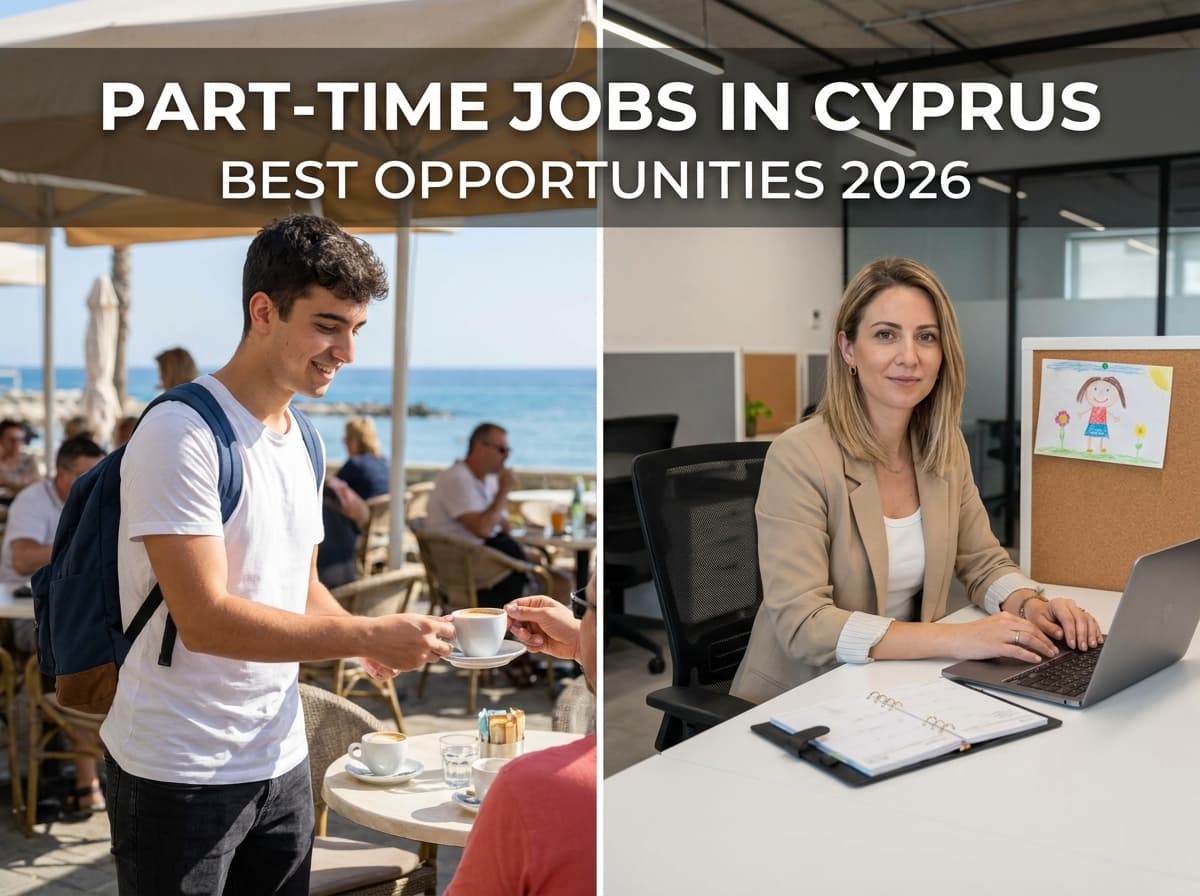
Part-Time Jobs in Cyprus: Best Opportunities for Students and Parents
Looking for flexible work in Cyprus? This guide covers the best part-time opportunities in 2026 — which sectors offer them, what they pay, and your rights as a part-time worker.